
Description
Invite authoritative stakeholders to a joint workshop (e.g. half- or full-day). Let them write quality scenarios to describe their specific quality requirements for the system. Moderate this workshop.
- Use scenarios to formulate specific quality requirements.
- Order those scenarios within a mostly hierarchical quality tree, similar to [ISO-9126].
Scenario-based Quality Description
- Scenario
- describes the reaction of a system to a certain event (or type of event).
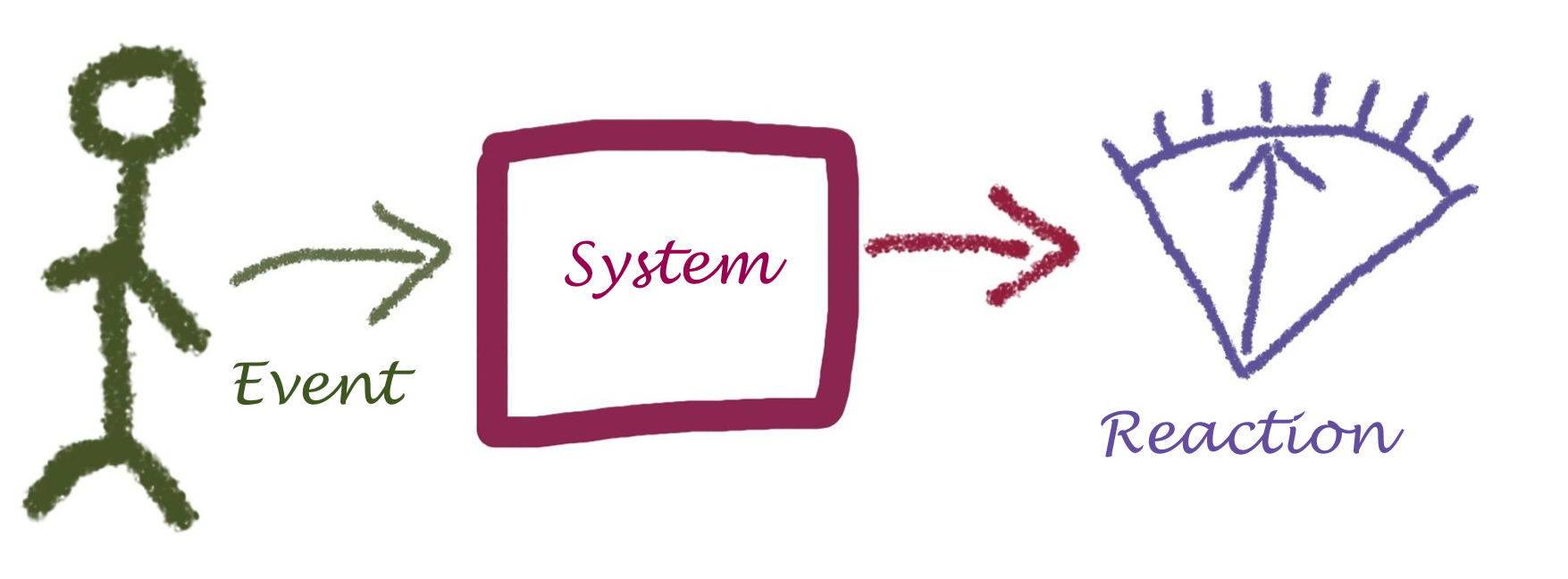
Although this definition is concise, it needs some explanation to become understandable. See figure Structure of Quality Scenarios:
- An event can be
- a user clicking a button
- an administrator starting or stopping the system
- a hacker trying to get unauthorized access.
- An event can also be
- a manager needing another feature
- another manager wanting to reduce operation costs
- some government agency requiring financial data to be tamper-proof
Example 1. Example scenario “Mandatory changes to Business Processes”
| Context | The individual processing step AB within use case XY is declared invalid by the regulatory authority and removed from the system. The data processed by the system is not affected. |
| Business Goal(s) | The needed changes to the use case XY can be carried out at low cost and without negative effects. |
| Trigger | The legislator, represented by the regulatory authority, prohibits the use of the AB processing step. |
| Reaction | A developer or architect removes the AB processing step in the system (by deleting the corresponding calls or reconfiguring the process flows). |
| Target value | The change requires a maximum of 24 hours with a maximum of 48 person-hours of effort. After this time, the system is fully working again. |
| Constraints | This change has no effect on the existing data of the users/customers in the system regarding the XY application case. An (automatic) migration of some data is permitted, but must not exceed the 24-hour limit. |
Such a scenario makes it clear to everyone that not only business functionality is needed to achieve the project’s goals. It makes technical requirements (in the example above: modifiability) visible to non-technical stakeholders by providing traceability from the business goal to the technical details.
Experiences
- Needs moderation: Brainstorming quality requirements usually works well in moderated workshops. If given (even trivial) examples, every stakeholder will most likely write down several scenarios. We often received 80-120 different scenarios in one-day workshops.
- Uncovers problems and risks: Scenarios collected within brainstorming sessions often contain hidden problem descriptions, risks or problems with the current systems.
- Covers organization and process: Scenarios sometimes cover process or organizational aspects (like release cycles should be faster than they are now). Move those to your Improvement Backlog.
- Improves human communication: Different stakeholders often start communicating about the system or their requirements during such workshops. This kind of interaction should have happened long before…
Applicability
Use this practice when (authoritative) stakeholders are available for discussion or a workshop.
If you have well-documented, specific and current (!) quality requirements available, you might consider skipping this practice for now (although we’re quite sure it’s a good opportunity to learn a lot about the system, its stakeholders, their requirements and opinions).
Consequences
- The required constraints (aka quality attributes) of a system are made explicit.
Also Known As
- Non-functional requirements (although this term is misleading, as functional requirements strongly influence the quality of any system!)
- Documentation of quality requirements.
References
The workshop-based collection of quality requirements has been described by [Clements-ATAM].
- Real-world examples of software quality requirements (currently available only in German): https://github.com/arc42/quality-requirements
- [Clements-ATAM] contains a brief description of scenario-based quality description and details on how to set up such workshops.