
Goals
Make the issues, problems and risks found during analysis comparable by estimating or measuring their value (that’s why we call this activity evaluate):
- estimate the value of problems, issues, risks and their remedies,
- prioritize issues, their remedies and improvement measures.
Usually, evaluation implies estimation; only in few cases can you measure or observe the evaluation subject and produce hard facts.
Estimation
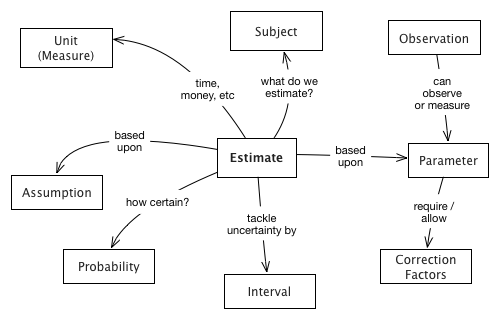
Evaluation Domain Concepts
| Domain concept | Explanation | Example |
|---|---|---|
| Estimation | an approximation of any subject (here: issues, problems or remedies), which is needed because facts or real observations are not available or possible. | |
| Subject | a recurring problem in the system or associated processes | |
| Parameter | an important element or foundation of the estimation. | • number of developers on the system • Lines-of-Code (LOC) |
| Assumption | a fixed setting for any parameter. See Explicit Assumption | |
| Observation | measure, count, calculate gather real data for parameters | if every developer is concerned by the problem, we count their number. |
| Interval | see Estimate in Interval | between 15% and 25% |
Patterns and practices for evaluation
-
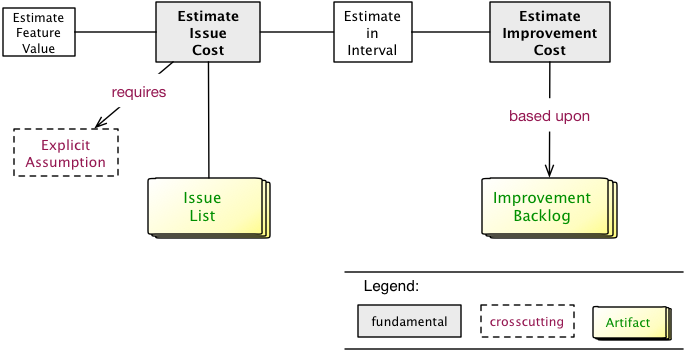
Estimate the (monetary) value of a given feature, so you can compare features of the system with each other.
-
Determine how much a specific improvement (a set of actions taken to eliminate or reduce a specific issue or problem) is likely to cost (in money and/or effort).
-
Estimate in intervals, giving lower and upper bounds.
-
Find out how much a given issue costs in units of money or effort in a period or for every occurrence.