
Description
Rewriting an old system with a big-bang approach is a risky endeavor. It is harder than you might think at the beginning.
An alternative way is to gradually create a new system around the edges of the old, letting it grow slowly over several years until the old system is strangled. The most important reason to consider a strangler application over a cut-over rewrite is reduced risk (it might cost more to do a strangler, but that’s the price of risk reduction) [1].
Paul Hammant depicts the strangler approach as follows [2]:
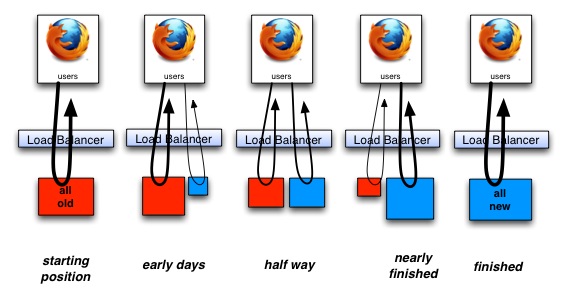
He discusses two ways of achieving the goal of moving from the (red) old system to the (blue) new system:
- with adding new features,
- without adding new features.
Deciding to go for the first strategy means that you can still keep your business happy because you are still able to deliver new features. However, this approach will take longer than the second one.
Experiences
- Paul Hammant reports the following positive
case studies:
- Airline booking system: the C++ application, which was stable but hard to grow (and to find developers for), has been incrementally replaced by a Spring stack based application. A load balancer routed the requests to either the C++ or the Spring application. They introduced a session store used by both systems (the C++ application needed to be adjusted for this).
- Trading company’s PowerBuilder based rich client: you cannot integrate a new rich client into an old one, so the team decided to run two client applications in parallel for the energy traders, adding more and more functionality to the new (Swing-based) client. The users weren’t forced to use one or the other, but the team made the new application so compelling that they wanted to. Google is (as I heard from a Googler) doing similar approaches to their internal systems, which are replaced by new systems all the time, and you need to decide when to switch.
- National supermarket’s internal planning system based on Swing and a major database is moving into a Rails and Java microservices based web application. Since the two technologies are also very different, there is no smooth way of integrating the old and the new system; they have to exist in parallel (it is an internal system).
- Used consumer goods magazine’s web portal: a move from Oracle Endeca to Java/JavaScript. First, they changed the Oracle frontend so that it looks like the new system. Then they integrated a little piece of new functionality from the new stack into the website. The first strangler release took 6 months, then they delivered regularly.
- Nat Pryce reports failed projects and challenges using the strangler pattern [3]:
- “I’ve seen critical systems that have suffered both of these fates, and ended up with about four or five ‘strategic architectural directions’ and ‘future state architectures’. One large multi-site project ended up with eight different new persistence mechanisms in its new architecture.”
- “Another ended up with two different database schemas, one for the old way of doing things and another for the new way, neither schema was ever removed from the system and there were also multiple class hierarchies that mapped to one or even both of these schemas.”
Risks
- You need to overcome the lack of will to actually finish the strangling (usually political will from non-technical stakeholders manifested as lack of budget). If you don’t completely kill off the old system, you’ll end up in a worse mess because your system now has two ways of doing everything with an awkward interface between the two. Later, another wave of developers will probably decide to strangle what’s there, writing yet another strangler application, and again a lack of will might leave the system in an even worse state, with three ways of doing things [1].
- You need to have consensus across the development team(s) on the future state of the architecture and how to get there. If everyone runs in another direction, then you end up with a new system which is also hard to maintain.
- If you’re introducing technologies that are new to the team or to support/maintenance staff (e.g. adding reliable async messaging to what is currently a synchronous three-tier client/server architecture) then you have to ensure that there are experienced technical leads on the project who know how to build systems with that technology and support those systems. And those tech leads have to stick with the project for some time after the old app has been fully strangled. Otherwise, the architecture will degrade as inexperienced developers modify it in ways they know but not in ways that fit with the new architecture [1].
- Strangling creates a layer of goo and there is a risk that this layer becomes a mess, too.
Applicability
- A big-bang replacement is too risky and/or your business wants you to constantly deliver new features and does not accept a 1–3 year break for the big rewrite.
- The “cost of delay” of not moving to the new platform as early as possible is higher than the cost of running two systems in parallel.
Proposed practices
Paul Hammant recommends the following practices [2]:
- You really should phase the strangulation. Keep your larger application in a continually deployable state while working on it. The first go-live after a month or so of work, then every two weeks after that at least, or you’ll fail — probably via project cancellation by a checkbook-holding sponsor.
- Do enhancements or new “business value” work concurrently with strangulation, while getting all to agree that both are happening. As you work on the strangulation, a decent percentage of work should be enhancements too. This allows value to be associated with each release from the point of view of the people paying for it. ROI and all that isn’t just abandonment of costly end-of-life IT choices, it is about tangible changes for the better. From top to bottom, everyone needs to agree that both are happening.
- The addition of integration and functional test suites as a safety net is key. This is particularly true when the old technology did not have unit test coverage. The functional tests will be able to step between old and new (and back), to prevent surprises.
- Understand that non-functional requirements (NFRs) that don’t directly cheapen the re-implementation may jeopardize the initiative — jeopardize in the “courting cancellation” territory again. Various authority figures may have pet technologies to include or things to exclude. The test is whether the dev team cranking stuff out agrees or not.
- Agile methodologies optimize everything for maximized developer throughput and phased deliveries to production. You will not manage this with waterfall, unless you want glacially long intervals between production pushes. The Pols/Stevenson white paper drills much further into the agile aspects.
- Lastly, you should always be aware that there could be functionality and context hidden within the old application that people have forgotten about, and that a team of business analysts assigned to reverse engineering behaviors might also miss. This is a risk for any “rewrite” though.
Related
- Replaceable Component Architecture
References
- [1] Martin Fowler about the Strangler Application
- [2] Paul Hammant’s blog post with practices and case studies
- [3] Discussion on StackOverflow with Nat Pryce and Ira Baxter
- Michael Feathers speaks on Hanselminutes about the Strangler Application