
Description
The Database Last approach, also called the Reverse Migration Method, is based on a similar concept to the Database First approach and is also suitable only for fully decomposable legacy systems. Legacy applications are gradually migrated to the target platform while the legacy database remains on the original platform. The legacy database migration is the final step of the migration process. As with the Database First approach, a gateway is used to allow for the interoperability of both information systems. In this case a Reverse Gateway enables target applications to access the legacy data management environment. It is employed to convert calls from the newly created applications and redirect them to the legacy database service, as shown in Fig. 1.
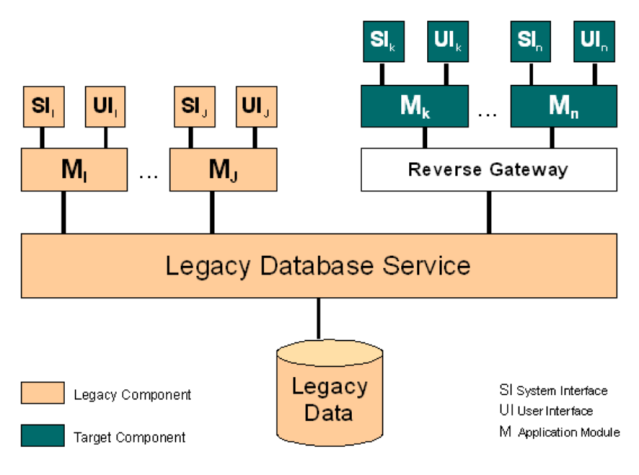
If the legacy database service is to be migrated to a relational database management service, then the target applications will be developed completely with SQL calls to the data service. It is these calls that are captured by the Reverse Gateway and converted to the equivalent legacy calls. The Database Last approach has a lot in common with the client/server paradigm. The legacy database takes on the role of a database server with the target applications operating as clients. There are commercial products available which effectively act as reverse gateways.
The Database Last approach is not without its problems however. Performance issues can be raised with regard to the gateway. The Reverse Gateway will be responsible for mapping the target database schema to the legacy database. This mapping can be complex and slow which will affect the new applications. Also many of the complex features found in relational databases (integrity, consistency constraints, triggers etc.), may not be found in the archaic legacy database, and hence cannot be exploited by the new application.
This approach is probably more commercially acceptable than the Database First approach as legacy applications can continue to operate normally while being redeveloped.
However, the migration of the legacy data will still require that the legacy system be inaccessible for a significant amount of time. When dealing with mission critical information systems, this may be unacceptable
(taken from BISBAL, J. et.al.)
References
- BISBAL, J. et.al.; A Survey of Research into Legacy System Migration. Technical Report TCD-CS-1997-01, Computer Science Department, Trinity College Dublin, 1997. http://citeseerx.ist.psu.edu/viewdoc/summary?doi=10.1.1.50.9051