
Description
In Composite Database approach, the legacy information system and its target information system are operated in parallel throughout the migration project. The target applications are gradually rebuilt on the target platform using modern tools and technology. Initially the target system will be quite small but will grow as the migration progresses. Eventually the target system should perform all the functionality of the legacy system and the old legacy system can be retired.
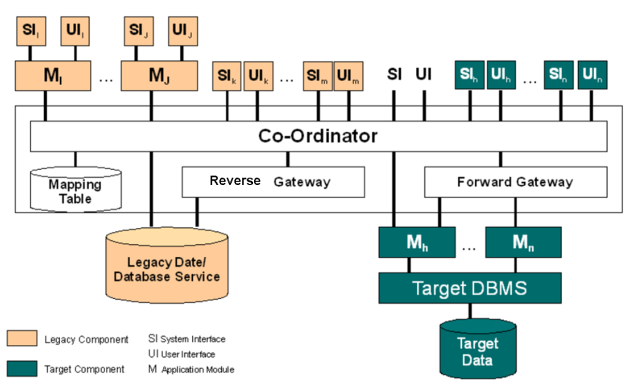
During the migration, the old legacy system and its target system form a composite information system, as shown in Fig. 1, employing a combination of forward and reverse gateways. The approach may involve data being duplicated across both the legacy database and the target database. To maintain data integrity, a Transaction Coordinator is employed which intercepts all update requests, from legacy or target applications, and processes them to identify whether they refer to data replicated in both databases. If they do, the update is propagated to both databases using a two-phase commit protocol as for distributed database systems.
Analysing non-decomposable legacy components can be very difficult. In the worst case the component must be treated as a black box. The best that can be achieved is to discover its functionality and try to elicit as much legacy data as possible. Sometimes using existing legacy applications (e.g. database query, report generation and access routines) are the only way to extract the legacy data. Once the functionality has been ascertained, the component can be redeveloped from scratch. It can often be very difficult to identify when legacy data or functions are independent. In many cases they may simply have to be replicated and target copies coordinated until the entire legacy system can be safely retired.
The Composite Database approach eliminates the need for a single large migration of legacy data as required in the Database First and Database Last approaches. This is significant in a mission critical environment. However, this approach suffers from the overhead not only of the other two approaches but also the added complexity introduced by the coordinator.
(taken from BISBAL, J. et.al.)
Applicability
The Composite Database approach is applicable to fully decomposable, semi-decomposable and non-decomposable legacy systems. In reality, few legacy systems fit easily into a single category. Most legacy systems have some decomposable components, some which are semi-decomposable and others which are non-decomposable, i.e. what is known as a Hybrid Information System architecture.
References
- BISBAL, J. et.al.; A Survey of Research into Legacy System Migration. Technical Report TCD-CS-1997-01, Computer Science Department, Trinity College Dublin, 1997. http://citeseerx.ist.psu.edu/viewdoc/summary?doi=10.1.1.50.9051
- Praful Todkar wrote the blog article “How to extract a data-rich service from a monolith” on martinfowler.com